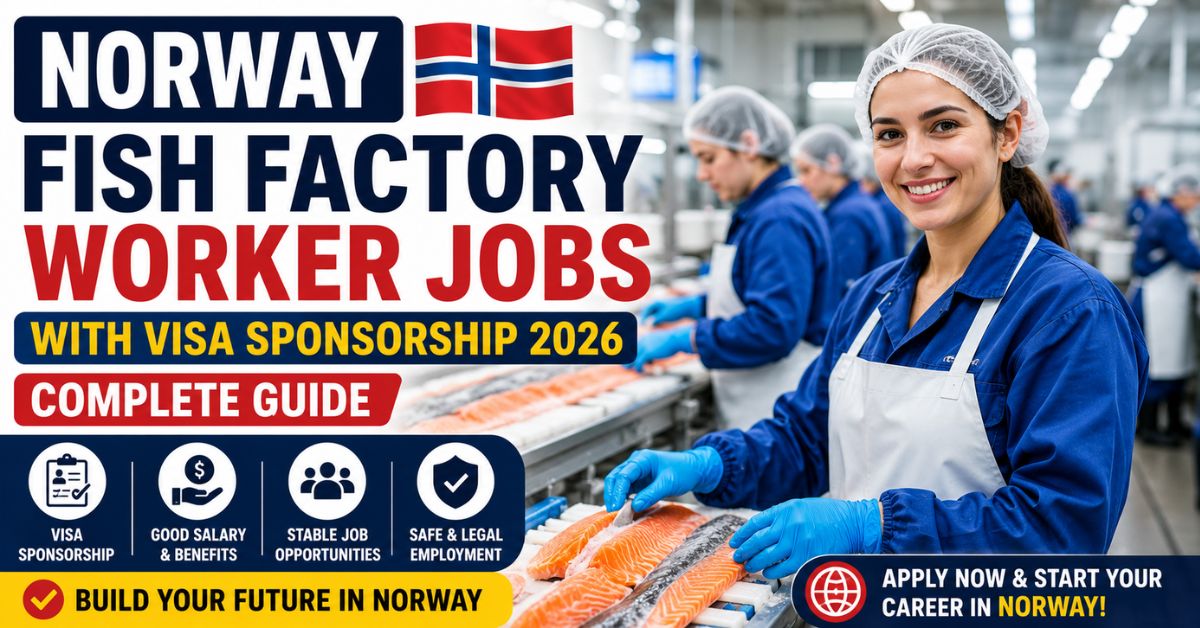
Norway Fish Factory Worker Jobs 2026 | Visa Sponsorship Guide
Norway’s stable industrial job market with competitive wages and a strong future outlook has made it one of the most desirable destinations in Europe for foreigners looking for stable jobs with long-term prospects. However, the most prominent of the expanding sectors are Norway fish factory worker jobs with visa sponsorship in 2026, as the seafood industry continues to grow and employers regularly seek extra workers. International workers are also common in Norway for the fish processing factories, seafood packaging companies or export centers, where there is a lack of workers, particularly during busy periods of production.
It is not easy to get reliable information on Norway work visa jobs for many seeking employment in Norway. There are fears of recruitment fraud, visa complications or bogus salary offers on the Internet. This is a detailed guide to give accurate, transparent and practical information on fish factory worker job in Norway 2026 for foreigners.
Norway Fish Factory Worker Jobs 2026 Overview
The Norwegian seafood sector is a key part of the Norwegian economy. The nation is also a significant exporter of salmon, cod, mackerel and other seafood products, each year. Seafood factories and processing plants are often hiring more employees to help package, clean, sort, freeze and ship seafood as demand continues to grow around the world.
Fish factory worker jobs are among the entry level industrial jobs that could be done by a lot of foreign workers without higher education and special training. Reliability, physical fitness, teamwork and willingness to work in production lines are usually more important to the employer.
Fish factory workers are essential to Norway in 2026
Norway’s seafood industry is still growing because of the demand for seafood exports on the international market. Factories may be in full production throughout the year and need workers to contribute to the processing of the factory efficiently and safely.
Employers take foreign labour because of the lack of trained manpower in physically demanding industrial jobs. Fish processing work may be shift work, cold work, repetitive work and be unsuitable for some local workers to work, which makes it challenging for some employers to get enough local workers.
Hiring needs also rise during the busy seasons. In times of peak exports, seafood processing plants could require more personnel in the packaging, sorting, and shipping departments.
One of the other key considerations is Norway’s robust export-driven economy. Seafood is still one of the key export sectors of the country, and optimising production chains is vital for export trade.
Norway Fish Factory Worker Salary Guide 2026
One of the main factors that attracts international workers to factory jobs in Norway is salary. In general, wages are higher in Norway than in other countries, but so are living costs.
The pay of fish factory workers in Norway ranges from NOK 32,000 to NOK 45,000 a month before taxes, depending on their level of experience, employer, shifts and overtime opportunities in 2026.
Additional Income Opportunities
At some factories, a selection of the following may be available:
- Overtime bonuses
- Night shift allowances
- Weekend shift pay
- Seasonal bonuses
- Productivity incentives
While taxes and expenses are relatively high in Norway, in many cases, workers gain from robust labor protection and regulated working conditions.
Visa Sponsorship Opportunities for Foreign Workers
International Employers seeking Foreign Workers (Foreign Workers looking for Work Visa Sponsorship)
Norway jobs with visa sponsorship are a popular target for foreign workers, as securing legal employment is necessary for those who do not hold EU citizenship.
Visa sponsorship or work permit assistance may be available for some seafood processing factories and companies in certain cases when there is a lack of manpower.
Common Visa Sponsorship Support
Employers can help by providing:
- Official employment contracts
- Work permit documentation
- Immigration paperwork guidance
- Relocation in some instances
However, the applicants should be aware that the visa is not guaranteed by the recruitment agent or employer, but rather by the Norwegian immigration authority.
Important Warning
Be wary of anyone or organization that guarantees visas or requires payment in advance for visas. Real employers have to follow the official immigration processes and offer clear contract agreements.
Main Responsibilities of Fish Factory Workers
The major duties of fish factory workers are:The principal duties of fish factory workers are:
The fish factory workers are playing significant roles in ensuring the quality of fish production and export standard.
Typical Job Duties
- Cleaning fish products
- Sizing and sorting seafood by type
- Packaging seafood products
- Performing simple, basic work with factory equipment
- Maintaining hygiene standards
- Development of products for shipment
- Restrictions on movement and equipment.
- Suspension of transportation and equipment.
- When in the workplace, adhering to safety rules
Suffocation from standing for extended periods and/or working in cold storage areas. Safety equipment and training at the workplace are typically provided by the employer.
Work Requirements and Qualifications
The availability of fish factory jobs are more readily available for workers without advanced education, but yet employers look out for a worker that has a good work attitude and can be depended upon.
Basic Requirements
- Valid passport
- Good physical health
- Ability to work shifts
- Students will have the ability to speak and write English in a basic manner.
- Ability to follow instructions
Preferred Qualifications
Some previous experience in a factory or warehouse.
- Food processing experience
- Comfortable with working in cold conditions
- Teamwork skills
- Strong work ethic
Most businesses offer on-the-job training, particularly training for safety and production standards, to new employees.
Benefits of Norway Fish Factory Worker Jobs
Norway Fish Factory Worker jobs offer a range of advantages.Norway Fish Factory Worker Jobs come with a variety of benefits.
Norway has a good reputation for a good labour market and robust employee protection. There are several fish factory careers with benefits for foreign workers.
Stable Employment Opportunities
Seafood processing is an important year-round industry in Norway.
Overtime Pay
During the high production season workers may receive extra pay.
Safe Work Environment
There are strict health and safety regulations that need to be adhered to within factories.
Paid Holidays
Vacation leave may be paid, based on contract.
Career Development Opportunities
Eventually workers will shift to:
- Production supervisor roles
- Warehouse operations
- Machine operator positions
- Quality control departments
International Work Experience
An employment in Norway can enhance future prospects in career development in the European Union and the international labour market.
Best Regions in Norway for Fish Factory Jobs
The best regions in Norway for employment in a fish factory are determined by the following factors:
A large number of fish processing plants are situated in coastal areas where the seafood industry is most developed in Norway.
Tromsø
The fishing and seafood processing industries are well developed in Northern Norway.
Bergen
Bergen is a key centre for seafood exports in Norway.
Ålesund
It is a coastal city famous for fisheries and seafood production factories.
Trondheim
The food processing and logistics industry is developing in Trondheim.
Northern Coastal Areas
Seasonal and full-time seafood factory jobs are also available in smaller coastal towns.
Step-by-Step Guide to Apply for Norway Fish Factory Worker Jobs
Getting it right might just tip the odds in your favor when chasing interviews plus landing roles that need a license to practice law.
Make a clear job resume
Your resume should include:
- Work experience
- Skills
- Contact information
- Language abilities
- When sources exist, include them
Keep the format simple and professional.
Find Verified Employers
Start your search on reliable job sites or go straight to a company’s own page. Some roles show up only where the business posts them directly.
Write a clear cover letter
Explain:
- Why you want the job
- Your experience
- Availability
- Open to moving if needed
Attend interviews
Interviews happen online sometimes when job seekers live abroad. A screen connects interviewer and applicant across borders. Distance doesn’t stop hiring if Wi-Fi works well enough. Companies skip travel by using video instead. Remote chats replace face-to-face talks overseas.
Get Your Job Contract
Start by checking how much you will earn, then look at the schedule. Housing facts come next – pay attention. Terms of agreement matter just as much.
Apply for Work Permit
Once you have the job papers in hand, start sorting out the work visa paperwork. The moment those official letters arrive, move forward with the permit steps needed by law.
Work Environment and Conditions
Faster rhythms shape daily work inside fish processing plants. Though built for volume, these spaces demand constant movement from those within.
Typical Working Conditions
- Cold temperatures in some sections
- Protective uniforms and gloves required
- Shift-based schedules
- Standing for extended periods
- Team-oriented work structure
Besides handling food safely, workers stick to cleanliness steps since overseas buyers demand high-quality seafood. Each step matters when meeting those tight rules.
Tips to Improve Your Hiring Chances
Improve English Communication
Most jobs on a production line need only simple English. Yet clearer speaking opens more paths over time.
Gain Factory Experience
Warehouse or production experience can strengthen applications.
Apply to Multiple Employers
Do not depend on a single job application.
Stay Physically Fit
Fish factory work can be physically demanding.
Use Professional Applications
A strong resume grabs attention right away. Communication that makes sense builds trust over time. Clear details stand out where confusion fades. Simple words often do more than complex ones. First thoughts stick when they are easy to follow.
Common mistakes to avoid
Paying Fake Job Application Fees
Always verify recruiters and employers carefully.
Trusting Overblown Pay Promises
Watch out for online ads that stretch the truth. Sometimes they make things seem better than they really are.
Breaking Work Permit Regulations
Working illegally can create serious immigration problems.
Submitting Poor-Quality Applications
A sketchy resume can mean fewer callbacks. Messy details often get overlooked fast. Hazy sections tend to confuse hiring eyes. Unclear work history might slow things down. Sloppy formatting sometimes hides strong skills. Missing pieces generally raise red flags.
Accepting Unofficial Agreements
Before you go, get a paper agreement signed by both sides. A trip needs clear promises on record. Never move without proof of terms in hand. Written words protect every part of the journey.
Places to Stay for Foreign Workers in Norway
For foreign workers heading to Norway, sorting out a place to stay often feels like the toughest part. Luckily, several fish processing employers get how hard that can be – some offer short-term lodging, others set up shared homes, while a few help point people toward low-cost rentals close by.
Out by the sea, where fishing plants run day and night, rent often drops below what you’d pay in big places such as Oslo or Bergen. Workers from abroad sometimes find rooms set up by bosses – a shared flat maybe, just until things feel less strange those early weeks on the job.
Common Housing Types for Workers
Shared Apartments
Sharing a flat helps cut costs for overseas staff. In places near factories, it happens often because people choose to live together instead of alone.
Company Accommodation
Some seafood companies offer basic housing facilities for seasonal or full-time workers. These accommodations may include:
- Shared kitchens
- Furnished rooms
- Laundry access
- Internet services
- Private Rentals
Some folks want space to themselves. Living alone fits different wallets. Where you are changes what you can find. A separate flat might work for some. Others pick smaller spots, like a single room. It really comes down to personal choice. Money plays a big role too. Location decides availability. Independence matters most for certain people.
Before signing any rental agreement, workers should carefully review:
- Monthly rent amount
- Utility costs
- Deposit requirements
- How far it is to get to work
- Internet availability
Getting clear on where to live before heading to Norway makes settling in smoother for workers. A surprise move often brings extra pressure – knowing housing details ahead of time prevents that. When living plans are set early, daily worries shrink once they land. Arriving without a place sorted might mean confusion piling up fast. Clarity about accommodation changes how easily someone adapts upon arrival.
Norway fish processing work culture
Most people think of Norway when fairness at work comes up. Factories there still follow clear rules about time and duties. Respect does not disappear just because the job gets messy. Safe spaces matter, even where machines run all day. Rights stay real, not theoretical, behind closed warehouse doors.
Team-Based Environment
Most days inside a fish plant run on shared effort. One person slows, others adjust fast just to keep pace without dropping standards.
Punctuality Matters
Promptness matters a lot to bosses in Norway. Being there when expected, sticking to plans without excuses – this kind of habit tends to open doors later on.
Respect for Safety Rules
Out in the processing zones, machines hum alongside chilled rooms where fish moves fast. Because cleanliness matters so much here, every person on site pays close attention to the rules. Steps get followed without skipping, since mistakes can show up quickly. Through each shift, care stays high near slicing tools and icy floors.
Professional Communication
Out of nowhere, a simple way to talk clearly might just strengthen how coworkers connect on the job. In Norway, showing respect matters – so does being open to picking up new things at work.
Workers from abroad tend to stay longer or move up when they fit into the workplace way of doing things. A good match with daily routines at work opens doors more easily than skills alone might. Those who learn how others communicate on the job usually see results over time. Getting used to small habits matters just as much as meeting targets. Staying past the first year often depends less on paperwork, more on quiet understanding.
Seasonal and Full Time Fishing Work in Norway
Every seafood job differs in its own way. Certain roles appear only at particular times of the year, whereas some continue without pause across all months.
Seasonal Fish Factory Positions
When harvests pick up or overseas orders rise, extra work tends to appear in coastal areas. Lasting a few months, these roles open doors for people seeking short-term jobs abroad. Sometimes it’s packing crews needed, other times transport helpers during peak shipping windows.
Benefits of Working Seasonal Jobs
- Easier entry into the industry
- Overtime opportunities during busy periods
- Valuable international experience
- Possibility of future re-employment
Still, jobs tied to seasons often come without promises of staying on.
Full-Time Factory Jobs
Working full time usually means a steadier job along with better perks down the road.
Full Time Jobs Come With Steady Pay And Extra Perks
- Stable monthly salary
- Consistent work schedules
- Better career growth opportunities
- Potential contract renewals
Some people doing good work on short-term jobs might eventually be asked to stay longer or hired full-time.
Working in a fish factory involves heavy lifting long hours cold conditions and repetitive tasks
One thing stands clear: working in a fish plant means long hours on your feet. When people know what to expect, settling in feels less jarring once they get there.
Common Physical Requirements
Workers may need to:
- Stand for long hours
- Lift seafood containers
- Work repetitive shifts
- Handle cold temperatures
- Maintain fast production speed
Factories normally provide protective equipment such as:
- Gloves
- Waterproof uniforms
- Safety boots
- Hair protection
- Thermal clothing for cold sections
Working well in organized settings matters just as much as having strong endurance when doing seafood processing tasks. Stamina helps keep pace throughout long shifts while clear routines support steady performance day after day.
How Long Does the Norway Work Permit Process Take?
Some delays pop up when forms have mistakes. The speed often ties to how busy officials are at the time. Paperwork from employers sometimes slows things down without warning.
What Slows Down Processing
- Completeness of documents
- Employer verification process
- Immigration application volume
- Applicant nationality
- Seasonal demand periods
Start strong by getting every paper right – messy forms get stuck in the system. That slows everything down fast.
Documents Commonly Requested
Most of the time, staff must hand over:
- Valid passport
- Employment contract
- Passport photographs
- When needed, school history or job background details go here instead
- Accommodation information
- Forms for moving to another country were filled out
Staying up to date on government immigration news matters – rules can shift without warning. What works today might not tomorrow, so keeping watch makes sense. Changes appear slowly, then hit fast. Following updates helps avoid surprises later down the line. Information flows unevenly; some find out early, others too late. Being alert means you’re never caught off guard.
Job Sites for Fish Factory Work in Norway
Job hunting through reliable online platforms keeps your search within legal boundaries. Most people find steady work by sticking to known sites that follow labor rules. These portals often screen employers before listing openings. Safety comes from knowing the site checks company backgrounds first. You avoid scams when applying via established networks built for honest hiring. Legitimate jobs show up regularly on services designed to protect applicants.
Common Places to Search
- Official company career pages
- European job portals
- Norway-based employment websites
- International recruitment agencies with verified licenses
Important Safety Advice
When applying online:
- Avoid sharing unnecessary personal documents too early
- Verify employer contact information
- Research company reviews
- Confirm official business registration if possible
Finding a real job usually means hearing back through proper messages, plus getting an agreement that spells things out plainly.
Also Read: Sweden Cleaner Jobs with Work Visa 2026 – Apply Guide
FAQs
-
Can foreigners apply for fish factory jobs in Norway?
Fish processing firms in Norway often bring in overseas staff when local hires fall short. Especially busy times of year push these businesses to look beyond national borders for help. Shortages hit hard during peak seasons, so outside workers fill the gaps. Production surges make it necessary to pull in extra hands from abroad. When demand climbs, foreign employees become part of daily operations across plants.
-
Is visa sponsorship available?
Not every company steps up to help with visa paperwork, yet a few do handle permits while handing out signed job agreements to overseas hires.
-
How much do people who work in fish processing plants usually earn in Norway?
Monthly pay usually lands from NOK 32,000 up to NOK 45,000. Experience shapes part of that figure. Overtime pushes it higher. Some months feel heavier in the wallet than others.
-
Previous factory experience required?
Some companies will teach you the ropes. A background in a plant or storage space helps, yet it is not always required. Learning on the job shows up now and then as an option. Hands-on work before might give a small edge. Still, fresh starters find their way in too.
-
English required for job roles?
Basic English communication is often acceptable in many international factory environments.
Final Thoughts
Jobs at Norwegian fish factories in 2026 might open doors for overseas workers wanting steady work on European soil. Because pay is fair, rules protect employees well, extra hours are possible, plus room exists to move up later. These roles could become a solid way into Norway’s expanding seafood sector. While visas get supported by employers, conditions stay clear under national labor laws. Work happens fast but follows strict safety steps every shift. Since demand for processed fish keeps rising, staffing needs grow too. Each position links directly to daily production goals across coastal sites. Though physical effort matters most, training helps newcomers adapt quickly. Living near plants often means quieter towns with reliable transit nearby. After months on site, some staff transfer to related warehouse or logistics tasks.
Still, getting visas right matters most – pick legit companies, stay clear about job hopes. Building solid resumes helps, so does learning how shops really run day to day. Talking well? That opens doors more than expected.
Fish jobs spread wide now that Norway sends more of its catch abroad, opening doors for eager hands willing to work in coastal plants. Workers from elsewhere might land steady roles where nets meet cold storage far north. Seafood hubs hum louder each year thanks to those arriving ready to pitch in. Some come chasing stable shifts near rocky shores, others follow word of teamwork on icy floors. Not every path leads offshore – some stick close to packing lines under bright lights.