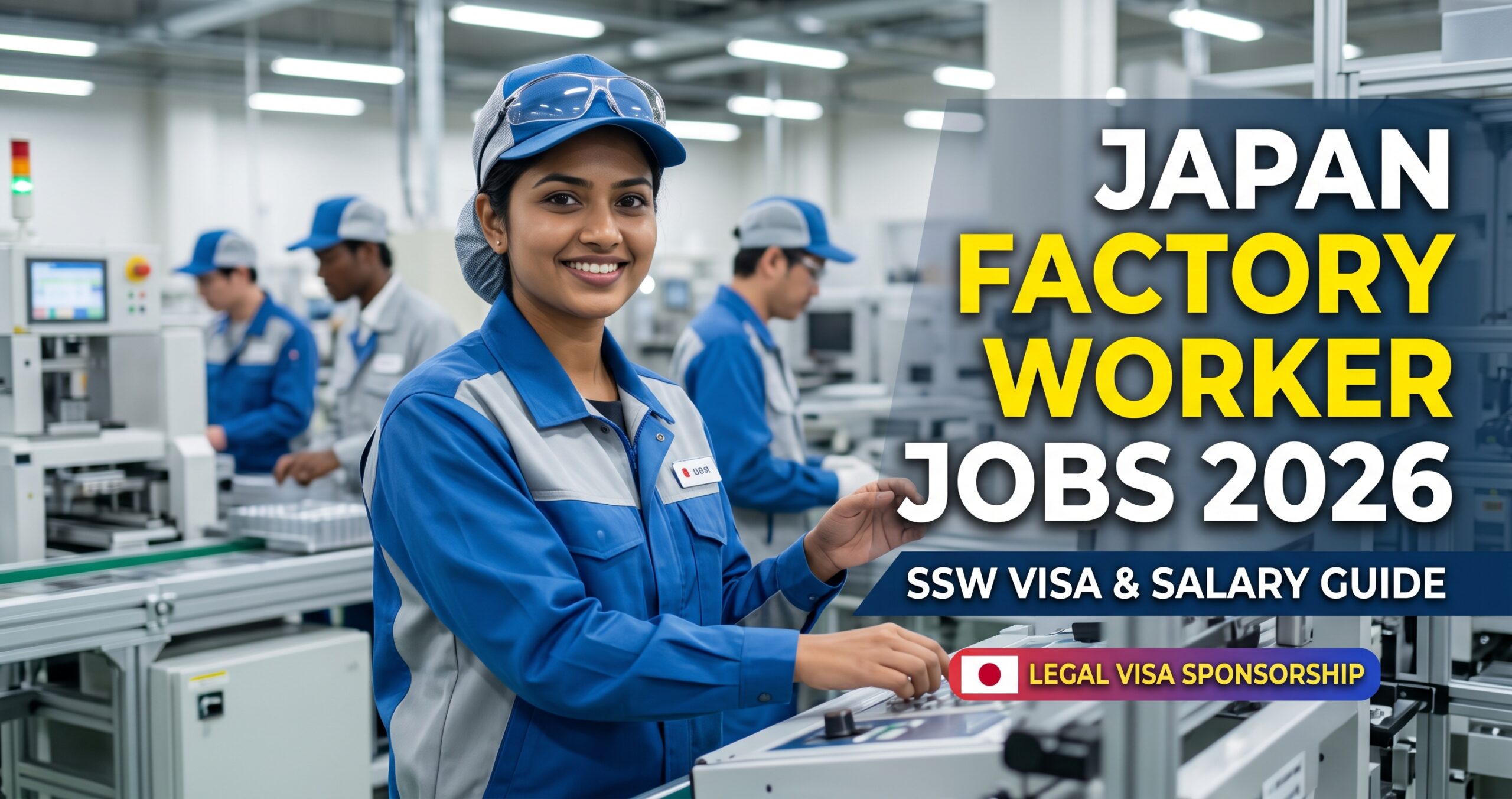
Japan Factory Worker Jobs 2026: SSW Visa & Salary Guide
Desiring a suitable and long tenure employment opportunity at one of the world’s most advanced manufacturing areas? Japan is ramping up its workforce in 2026 in order to meet a high demand for its industrial and food products on the international market. When the country has to deal with a drastic population change and a retiring domestic labor population, Japan has made it clear and legal for foreigners to fill the needed job vacant inside the manufacturing.
At the heart of this is the Specified Skilled Worker (SSW, Tokutei Ginou) visa program. The SSW visa is set up for people from outside Japan who have a talent for working in the country, providing them with a guaranteed invitation to become a legal citizen with a salary comparable to those of Japanese citizens and the benefit of Japanese labor laws. Unlike past trained visa programs, the SSW visa will grant you the opportunity to establish a career because you’ll be paid as a full employee, possibility to reach permanent residency status, and eventually, you can even bring your family with you to Japan.
What is the Japan SSW Visa for Factory Workers?
The Specified Skilled Worker (SSW) visa is a visa directly introduced by the Immigration Services Agency of Japan for blue-collar and skilled workers to live and work in Japan. The program is aimed, specifically, to address the skilled labor shortage in 16 targeted industries, including manufacturing, one of the most significant and large industries.
In the factory segment, the SSW visa is basically split into two:
- SSW Type 1): This visa is available to those who have basic conversation skills of Japanese and have experienced some practice in a chosen manufacturing skill.
- Duration: The stay in Japan can be for a maximum of 5 years. The visa period is usually 4 months, 6 months or 1 year.
- Family Accompaniment: Under SSW Type 1, you generally cannot bring your spouse or children to Japan.
- Job Mobility: If your factory situation is appropriate, you can legally move your factory to another licensed factory provided you have all the necessary notifications regarding immigration.
- SSW Type 2 For highly skilled workers with extensive experience, advanced examination (National Trade Skill Test, etc.), and leadership positions in the factory.
- Duration: stays are not limited to any specific length. This visa can be renewed permanently which opens the opportunity to apply for Japanese Permanent Residency (PR).
- Family Accompaniment: SSW Type 2 holders can legally have their family members (spouse and children) live in Japan with them.
You begin as an SSW of type 1 and your path is a clear one that will recognize your hard work and learning and open the door to a permanent life in Japan.
Top Manufacturing Sectors Hiring in 2026
The SSW concept arranges the factory jobs in the different types of industrial fields. In 2024, the Japanese government overturned the visa class structure, leading to the format of manufacturing visa jobs being streamlined. The two biggest manufacturing industries in terms of jobs in 2026 will be Industrial Product Manufacturing and Food and Beverage Manufacturing.
The industrial products were made.Industrial products were produced.
Manufacture of Industrial Products
Machining Workers, Workers in Factory Sheet Metal, Pressing Workers – Metal, Fab Workers – Electronic, Electroplating Workers, Electrical Equipment Assemblers, Anodizing and Coating Workers – Aluminum, Inspector, testers, Samplers and Counters – Metal and nonmetal.
- Typical Roles: Machining Workers, Workers in Factory Sheet Metal, Pressing Workers – Metal, Fab Workers – Electronic, Electroplating Workers, Electrical Equipment Assemblers, Anodizing and Coating Workers – Aluminum, Inspector, testers, Samplers and Counters – Metal and nonmetal.
- Work Environment: Work Environment These factories range from huge, factory style automotive manufacturing plants (manufacturing parts for big brand foreign manufacturers) to more specialized mid-size manufacturing shops (producing precision parts). Physical activity, safety conscious, and often dynamic shift schedules.
Manufacture of Food and Beverages
The food manufacturing sector is experiencing an unprecedented labour shortage in the context of Japan’s ageing population with increasing demand for ready-to-eat food and the rapid rise of food exports to the world.
- Typical Roles: Processing raw materials; operating industrial baking or cooking equipment; packaging finished products; conducting quality checks and effective sanitation measures.
- Work Environment: They will have to follow extremely strict hygiene measures – for example, in a meat processing plant they may work in temperature-controlled areas (refrigerated areas, heated areas near industrial ovens) – and at all times.
Both industries provide fairly strong security, however, you may experience a very different day-to-day environment and set of skills tested as candidates.
Realistic Salary and Benefits for Factory Workers
One of the most appealing points of the SSW program is that it is a legal requirement for foreign workers to be paid at least as much as a Japanese person in the same position doing the same work. In the SSW system there’s no “cheap foreign labor” as your salary rate is regulated by the Japanese labour law.
Average Monthly Earnings
The basic monthly salary for a factory worker of the SSW Type 1 in 2026 is around ¥200,000 – ¥250,000 (Japanese Yen) per month for a 40-hour work week. But, the manufacturing sector is often shift working and overtime, so overall earnings can be a lot higher. The minimum wage varies according to the region; in rural areas it may be as low as ¥180,000 a month gross whilst in Tokyo and Kanagawa it could be higher at ¥300,000 per month or more, depending on shift work.
The Power of Allowances and Overtime
In the Japanese factory, base pay is just one component of a worker’s salary. Most factories run two or three shifts which require workers to receive a bonus:
- Overtime Premium: If working over 8 hours a day, 40 hours a week, increase your hourly base rate by at least 25%.
- Late-Night Premium: If work happens to be done from 10:00 PM to 5:00 AM, it has a premium of 25%. Working the night shift, you will make a lot more money.
- Shift Allowances: Shift Allowances are defined as a fixed shift allowance (such as ¥1,500) per night shift in addition to the legal premium, which many companies pay. Over a month, this can add ¥20,000 to ¥40,000 to your paycheck.
- Seasonal Bonuses: Some industrial manufacturers, larger ones at least, offer some sort of “summer bonus” and/or a “winter bonus” to certain wages, typically ranging from 1% to 4%.
Deductions and Take-Home Pay (Net Salary)
It is crucial to understand that your uncivilized salary is not what influences your bank account. In Japan, one and all contributes to a robust social protection net. Expect about 15% to 20% of your gross pay to be removed mechanically for:
- Income Tax (National)
- Resident Tax (Local)
- Health Insurance (Protections 70% of all medical, dental, and treatment costs)
- Pension Contributions (You container apply for a lump-sum compensation of your pension when you consent Japan)
- Employment Insurance
If your uncivilized salary is ¥250,000, your take-home pay will expected be around ¥200,000 to ¥210,000.
Living Costs and Savings Potential
Many factory employers deliver company dormitories or subsidized bed-sitters, keeping rent very low (e.g., ¥30,000 to ¥50,000 per month). Because factory settlements have lower charges of living than central Tokyo, a frugal worker can straightforwardly save ¥50,000 to ¥100,000 per month to direct back home as allowances or build their reserves.
Eligibility and Strict Requirements for SSW Sponsorship
Therefore, the standards of the Japanese government for the SSW visa are high, guaranteeing the workers’ readiness to meet the cultural and technical requirements of the country. You have to satisfy the below-listed mandatory criteria for 2026 for a factory job under SSW program.
Age and Background
- Must be 18 years or older.
- The candidate will have to be physically fit and able to stand for the full shift or do manual work.
- Your criminal record must be clean and have no record of you breaking the Japanese immigration law, such as over staying your visa.
Japanese Language Proficiency
Good communication is essential when it comes to safety on a factory floor. Passing one of two standardized tests will demonstrate your language skills:
- JLPT (Japanese-Language Skill Test) Level N4 or higher: This old-style test is held twice a year and verifies you appreciate basic, conversational Japanese.
- JFT-Basic (Japan Foundation Test for Basic Japanese) Level A2 or higher: A computer-based test obtainable more frequently in a lot of Asian countries, exactly designed to gauge average communication skills for SSW hopefuls.
Field-Specific Skills Evaluation Test
You cannot apply for a generic “factory job.” You must permit the specific Parametric computer-based exam for your selected sector:
- Manufacture of Trade Products Skills Evaluation Test
- Food and Potion Manufacturing Skills Calculation Test
These examinations test your theoretical information of the industry, protection conventions, machinery operation essentials, and quality regulator concepts. The assessments are often available in local dialects in major distribution countries (like the Philippines, Indonesia, Nepal, Vietnam, etc.) as well as in Japanese.
A Valid Job Offer (Sponsorship)
Passing the language and skills tests does not repeatedly grant you a visa. You obligation secure a formal employment agreement from a licensed Japanese manager (the “Compliant Organization”). Only companies that chance strict labor values and have a showed support plan for foreign workers are officially permitted to hire SSW candidates.
Step-by-Step Guide to Getting Your SSW Visa
Because it takes time and hard work to move from your home country to the factory floors of Japan. After joining studies it takes around 6-12 months to reach Japan. “Here’s the chronological roadmap:”
Step 1: Study Japanese and Pass the Language Test
Don’t wait to learn Japanese. Sign up at a good language school or go through good online language resources. The aim is to successfully pass the exam for JLPT N4 and/or JFT-Basic A2. A dedicated study of approximately 300-400 hours is usually required.
Step 2: Prepare for and Pass the Skills Test
Decide on what sector of industry you wish to work in. Download the official study manuals using the following testing portals which may be run by Prometric. This manual can be downloaded for free. Learn the safety, hygiene and mechanical aspects of the trade and take and pass the relevant skills signed up to in your country.
Step 3: Find a Sponsoring Employer
Once you have your two temporary permits (Language + Skill), you are fully qualified. You can find jobs from side to side:
- Approved Sending Organizations: Government-approved recruitment activities in your home country.
- Registered Support Organizations (RSO): Activities in Japan that help bond foreign talent with local companies.
- Direct Job Portals: Dedicated online job boards pointing SSW entrants.
Step 4: The Interview and Contract Signing
Attention is highly expected to be an online video interview with the Japanese factory managers. They will evaluate your Japanese communication skills, your interest, and your cultural appropriateness. If accepted, you will come into a formal employment contract. Make sure the details of what you will be receiving for base salary, hours worked, overtime compensation and housing goods are clearly outlined in the contract.
Step 5: Certificate of Eligibility (CoE) Application
Your documents will be submitted to your new employer in Japan and they will make a Certificate of Eligibility (CoE) request on your behalf. This step generally takes 1 to 3 months. This document, issued by the Japanese government, is a proof that you have fulfilled all of the legal requirements for admittance into Japan..
Step 6: Visa Stamping and Travel
Upon receipt of the CoE from your employer in your country, please drop off the paper or electronic CoE along with your passport and visa application at the Japanese Embassy or Japanese Consulate in your country. Typically, it takes approximately one week to process a visa. From there on, you can make sure to book your flight, get in the country, pick up your Residence Card at the airport and start your new job!
Expert Tips to Secure a Factory Job in Japan
Competition for the finest factory jobs—those through high profits, good houses, and generous spring bonuses—is fierce. At this time is how you can opinion out to Japanese employers:
- Aim for JLPT N3: While N4 is the least possible legal obligation, Japanese factory managers decidedly prefer entrants who hold an N3 certificate. An N3 level income you can understand composite safety instructions and connect well with your line leaders, making you a safer and more appreciated employee.
- Show Cultural Readiness: Japanese factories work on strict rules concerning punctuality, sanitation (the 5S system: Sort, Set in order, Shine, Order, Sustain), and teamwork (Ho-Ren-So: Statement, Connect, Consult). During your conference, explicitly mention your inclination to adapt to these ethnic norms.
- Focus on Long-Term Goals: Employers participate significant time and money into supporting your visa. They do not want superstar who will quit after a year. Direct your desire to stay for the occupied 5 years, upgrade to SSW Type 2, and build a permanent profession in their company.
- Highlight Physical Stamina: Factory work often involves standup for 8 hours, lifting, and working night shifts. Be transparent about your well-being and your enthusiasm to handle physical labor without objection.
Common Mistakes to Avoid During the Process
Unfortunately, the international employment industry has its segment of bad performers. Protect yourself, your moneys, and your upcoming by avoiding these dangerous errors:
- Paying Illegal Placement Fees: Sincere employers in Japan pay the employment agencies for conclusion talent. Under the laws of many distribution countries (like the Philippines’ DMW regulations), charging exorbitant assignment fees straight to the worker is strictly delimited or entirely illegal. If an intervention demands thousands of dollars honest for a “guaranteed visa,” walk present immediately. It is possible a scam.
- Faking Documents: Never stand up to fake JLPT permits or falsify your work history. Japanese Settlement uses advanced confirmation systems. If you are fixed submitting fraudulent documents, you will be forever disqualified from entering Japan.
- Ignoring Contract Details: Before signing everything, verify whether the repeated salary is “Gross” (formerly taxes) or “Net” (take-home pay). Squared if housing costs are deducted from your salary, and approve the exact hourly rate for overtime. Ensure you appreciate the shift arrangement.
- Applying for the Wrong Skill Test: Confirm the services test you take effortlessly matches the job you want. You cannot use an agriculture services test certificate to spread over for an industrial creation work job.
FAQs
-
Can I change my job while in Japan on an SSW visa?
Yes. Unlike the grownup TITP system, SSW Type 1 visa holders take the legal correct to change employers, providing the new job falls within the same designated industrial subdivision and the new company is qualified to sponsor SSW workers. You necessity notify the Immigration Services Agency within 14 days of the transformation.
-
Do I need a university degree to apply?
No. The SSW factory visa does not want a bachelor’s gradation. Your suitability is created entirely on passing the Japanese dialectal test and the field-specific services test, making it an incredibly available route for blue-collar specialists.
-
Will the Japanese government provide me with housing?
The government does not offer housing, but your employer is officially obligated to support you in finding suitable accommodation. Many business companies own private residences and will deduct a small, backed rent fee straight from your pay.
-
Can I bring my family to Japan?
Under the original SSW Type 1 visa (maximum 5 years), personal supplement is not allowed. However, if you promotion your skills, pass the necessary advanced tests, and safe the SSW Type 2 visa, you will be legally permitted to bring your spouse and children to Japan.
Final Thought
Securing a Japan workshop worker job in 2026 through the Specified Skilled Worker (SSW) visa program is an incredible opportunity for those willing to put in the effort. By offering equal pay, strict legal safeties, and a viable pathway to long-term placement, Japan has created a system that genuinely values international talent.
Achievement, however, requires immense dedication. You must require to studying the language, pass the rigorous Prometric skills tests, and carefully navigate the sponsorship procedure while avoiding unscrupulous enrolment agencies. Keep your goals clearly in sight, follow this guide step-by-step, and you will be well on your way to building a satisfying, profitable, and protected career in Japan’s thriving industrial landscape.