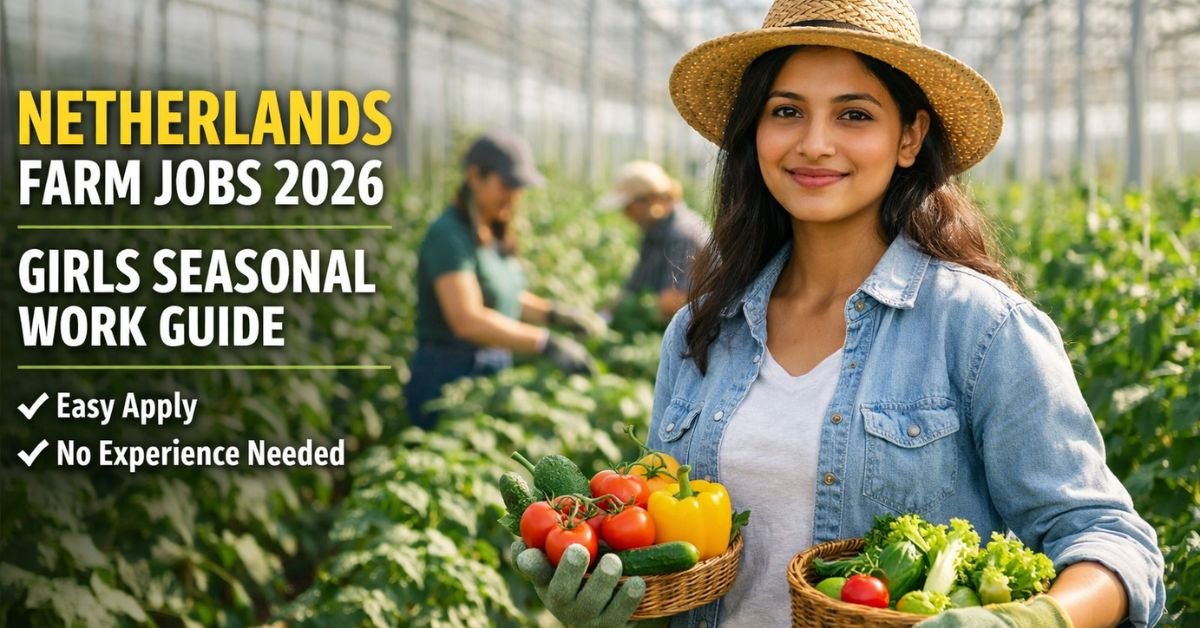
Farm Worker Jobs in Netherlands 2026 – Seasonal Apply Guide
One of the biggest aspirations of many people is to get a stable job opportunity in another country, particularly one with higher income, international exposure, and having a more secure future. Nonetheless, the visa procedures, employment opportunities and the procedure of application can be quite daunting at times, especially among non-skilled or low-level employees. It is here that the jobs of farm workers in the Netherlands become a viable and feasible viable alternative in 2026.
The agricultural sector in the Netherlands is very strong and needs seasonal workers continuously, particularly, when it comes to planting and harvesting. Not only are these jobs available to foreign workers but they also offer good wages, controlled working conditions and chances to experience international work.
Overview of Farm Worker Jobs in Netherlands
- The jobs of farm workers in the Netherlands are mostly seasonal and in the fields of agriculture and horticulture. These are jobs that are generally associated with planting, harvesting, sorting, packing and work in green houses. The agricultural system in the country is highly developed and so, there is always a requirement of temporary employees, especially during the high season.
- The Netherlands is also associated with the use of modern methods of farming, such as greenhouse farming, flowers and vegetables. This implies that employees are usually working in well-organized places with the right safety measures and work schedules.
- International workers are particularly fond of seasonal jobs since they are not necessarily associated with high qualifications and previous experience. Newcomers can easily adapt because they are usually trained to do simple tasks by their employers.
- In the year 2026, the demand will be not too intense, and the possibilities will be offered by licensed recruitment agencies, hiring by employers, and European labor programs. All these positions could act as a stepping stone to persons who aspire to have international work experience or a stepping stone to other more permanent opportunities in future.
Key Highlights for 2026
- High demand for seasonal agricultural workers
- Most jobs do not need any higher education.
- Average wage per hour: €10-14 (based on experience and employer)
- There are legal working hours that have an overtime option.
- Greenhouse farming, picking fruits and harvesting vegetables.
- Many cases: employer-assisted accommodation.
- Safe and regulated working environment
The Dutch government has stringent labor policies, and workers receive reasonable wages and are treated as per the EU standards. This further provides an additional security to foreign applicants.
Types of Seasonal Farm Jobs in Netherlands
Fruit Picking Jobs
One of the most typical seasonal jobs is fruit picking. During the peak seasons, workers are employed to harvest apples, strawberries, blueberries among other fruits.
Responsibilities:
- Selection of ripe fruits.
- Sorting and packing fruits and vegetables.
- Maintaining hygiene standards
Greenhouse Worker Jobs
Greenhouse farming is renowned in the Netherlands. The employees of this industry help to cultivate vegetables, flowers, and plants in a controlled environment.
Tasks include:
- Planting seeds
- Crop watering and crop monitoring.
- Vehicular harvesting, such as cucumbers and tomatoes.
Vegetable Harvesting Jobs
These positions include outdoor jobs in farms or fields to collect crops like potatoes, carrots and onions.
Key duties:
- Manual harvesting
- Packing and loading produce.
- Cleaning work areas
Flower Farming Jobs
The Netherlands is a worldwide flower producer. Planting, cutting and packaging flowers frequently require seasonal labor.
Common tasks:
- Handling delicate flowers
- Sorting by size and quality
Preparation of flowers to be exported.
Salary and Benefits
In the Netherlands, the wages paid to farm workers depend on the type of work, the employer and working hours. Nevertheless, the vast majority of seasonal workers are likely to receive a decent regulated income.
Average Salary
- Hourly wage: €10 to €14
- Monthly earnings: €1,500 to €2,200 (approx.)
Additional Benefits
- Extra hours overtime.
- Accommodation by an employer (in a few instances)
- Transportation assistance
- Health insurance coverage (compulsory in most instances)
Safe working conditions according to EU labor laws.
Although such positions can be not very well paid as compared to professional jobs, they offer a regular source of income and a great chance of working in Europe without any legal problems.
Eligibility Requirements
In the Netherlands, to be able to apply to farm worker jobs in 2026, the candidates are required to meet some of the basic requirements.
General Requirements
- Minimum age: 18 years
- Valid passport
- Basic physical fitness
- Ready to work in the manual field.
Basic knowledge of English (not necessarily but useful)
Experience
Majority of jobs do not demand any prior experience. But experience in farming, gardening, or labor work may add to your selection.
Documentation
- Updated CV
- Passport copy
- Recent photographs
- Work permit or visa papers.
Work Visa and Legal Process
To work in the Netherlands legally, non-EU citizens will need a working permit and visa.
Work Permits
- Seasonal Work Permit
- Temporary Employment Visa
Employers usually apply for the work permit on behalf of the worker. Upon approval, the candidate is then allowed to continue with the visa application process.
Important Notes
Always apply in official or confirmed means.
- Do not apply to unverified agents or searches.
- Make sure that the documents are authentic and full.
It is also necessary to follow the legal procedure to prevent inconveniences and have a good working experience.
Step-by-Step Application Guide
Step 1: Jobs Search
Find such jobs of farm workers on:
- Official job portals
- Recruitment agencies
- Employer websites
Step 2: Prepare Your CV
Prepare a plain and straightforward CV and to emphasize:
- Basic personal details
- Experience (work experience, as such)
- Skills related to physical work
Step 3: Apply Online
- Apply online by:
- Company websites
- Job portals
- Email applications
Step 4: Interview (when necessary)
An online interview can be done by some employers to determine your suitability.
Step 5: Go to Job Offer
You will be sent an official job offer letter should you be selected.
Step 6: Work Permit & Visa Process
Your employer will help you to apply the work permit. Once you are approved, you may apply to get a visa.
Step 7: Go to Netherlands
When your visa is accepted, you will be able to travel and legally work.
Farm Worker Living Conditions in the Netherlands
- Learning about the conditions of living is a significant aspect of the preparation of farm worker jobs in the Netherlands. Their employers offer accommodation to most seasonal workers particularly in rural farming regions where Housing might be a problem.
- Usually, accommodation is shared, like in dormitories, mobile units or small apartments. Depending on the facilities of the employer, workers can share rooms with 2-4 people. Although this might not be luxurious, it is relatively clean and safe, and has simple facilities such as beds, heating, access to a kitchen, and a bathroom.
- The accommodation cost is often billed at a reasonable fee at the expense of the salary of the worker, as stipulated by the Dutch labor laws, in most instances. Certain employers can pay free accommodation although this is relative.
- There is usually an arrangement of transportation between the workplace and the accommodation. Employers can offer bicycles or vans or transportation services which are organized, particularly when farms are distant to the residence.
- In general, living conditions are to be practical and functional, so, workers may concentrate on work and have a minimum level of comfort and safety.
Daily Routine and Work Environment
The Netherlands has a systematic and regimented farm work. Employees will also be required to be guided by seasonal requirements, the weather, and production objectives.
An average working day begins early in the morning, most of the times between 6:00 AM and 8:00 AM. Depending on the season of the year and workload, shifts can be 6-10 hours. Overtime can be enforced especially during peak harvesting seasons, but this is normally paid as per the labor laws.
The workplace is different in accordance to the kind of work:
- Outdoor farms: Workers are subject to weather conditions, which can include sun, wind or rain.
- Greenhouses: Greenhouses are controlled environments with constant temperatures and physically active tasks.
- Packing facilities: Indoor facilities devoted at sorting and packaging produce.
Employers are required to follow strict safety guidelines. Minimal safety training is offered to workers through provision of gloves, uniforms, and some basic safety training.
Breaks are incorporated in the shifts and workers are able to take their rest and continue to be productive during the day.
Living expenses in the Netherlands
The cost of living in the Netherlands is a crucial fact to know before seeking employment in a farm. Despite a fair level of wages, the cost may differ according to the lifestyle and places.
Simple Monthly Costs (Estimate)
- Accommodation: €250 – €500 (if not free)
- Food: €150 – €300
- Transportation: €50 – €100
- Health insurance: €100 – €150
Seasonal employees tend to save money as they can share a home and even cook themselves. It is possible to save part of your salary as many of the costs are partly paid or subsidized by the employers.
The cost of living in the Netherlands is moderate as compared to most of the other European countries though budgeting remains a key concern in financial stability.
Dutch Workers rights
The labor laws in the Netherlands are strong to ensure the protection of both local and international workers. As a farm worker, you have some rights that guarantee your fair treatment and safe working conditions.
Key Worker Rights
- Minimum wage protection
- Safe and hygienic working conditions
- Regulated working hours
- Paid breaks and rest periods
Discrimination and exploitation protection
The employers should present clear contracts that define the jobs, salary and working conditions. Employees are also entitled to complain against unfair treatment to the labor authorities.
Learning your rights will enable you to work with confidence and prevent possible complications in your working process.
Demand by Season and When to apply
The employment of farm workers in the Netherlands is very seasonal, i.e. there are periods of high demand of jobs.
Peak Seasons
- Spring (March – May): Planting and greenhouse work
- Summer (June -August): picking of fruit and harvest.
- Autumn (September-November): harvesting and packing vegetables.
It is preferable to apply 2-4 months prior to the start of the season. This gives time to go through applications, get a job offer, and visa processing.
Early submission will maximize the likelihood of being selected, particularly at peak times.
Job Contract and Employment Terms
Your employer will provide you with an employment contract before commencing your job. This is a valuable document that must be looked at keenly.
What the Contract Includes
- Job role and responsibilities
- Pay and remuneration system.
- Overtime and working hours policy.
- Accommodation information (where available)
Duration of employment
Seasonal jobs are normally on short-term contracts of a few weeks up to a few months. Employers can give some workers some extensions of the contracts based on performance and employer demands.
Always make sure that the contract is made understandable and in a language that you understand or seek help.
Salary Deductions and taxes
Employees in the Netherlands have to pay taxes on earnings. The tax system is, however, clear and deductions are clearly stated on your payslip.
Common Deductions
- Income tax
- Social security contributions
- Health insurance
- Accommodation (if applicable)
Workers generally get a fair net-income even after deductions. Some seasonal workers might claim partial tax refunds, based on the amount of their earnings and the number of days they stay.
Knowing your payslip assists in monitoring your earnings and use your finances wisely.
Health and Safety Regulations
The Netherlands do not underestimate health and safety, particularly in occupations that are physically demanding, such as farming.
It is the duty of the employers to provide:
- Basic safety training
- Protective clothing (gloves, boots etc.)
- Proper tools and equipment.
- Clean working environments
The workers should also adhere to safety measures and report on any dangers or injuries as soon as possible.
Healthcare is compulsory and workers must be covered by health insurance when staying. This makes sure that medical help is provided when required.
Work Ethics and Cultural Environment
Netherlands is characterized by professional and organized work culture. Punctuality, honesty, and teamwork are appreciated by employers.
Key Cultural Aspects
- Due respect in time and schedules.
- Direct communication style
- Equal treatment of employees.
- Pay attention to productivity and efficiency.
The environment is usually accommodating and welcoming to international workers. Nonetheless, it is possible to adapt to the local work ethics and communication styles and become more integrated.
Respect, responsibility, and co-operation can create a good impression and can lead to new opportunities in future.
Jobs That Last Longer Than Seasons
Farm work might not last forever, yet it opens doors to different paths across the Netherlands or even wider in Europe.
Some workers use seasonal jobs to:
- Gain international work experience
- Improve language skills
- Build professional connections
- Explore long-term employment options
Even if temporary jobs won’t secure long-term status, they often open doors through hands-on learning. A chance to grow might come quietly, tucked inside daily tasks. What feels short-lived could shape what comes next in ways not obvious at first.
How to Get Hired More Quickly
- Apply early before the peak season
- Use trusted job platforms only
- Keep your CV simple and professional
- Be flexible with job roles
- Learn basic English communication
- Avoid agents asking for high fees
Ready ahead of time means better odds at landing work. Starting early shifts the balance in your favor. Knowing what comes next helps you move without waiting. Planning steps beforehand removes last-minute noise. Staying one step ahead clears space for progress. Moving before asked makes room for results. Seeing around corners keeps surprises small.
Common Mistakes to Avoid
- Applying through unverified sources
- Submitting incomplete documents
- Ignoring visa requirements
- Expecting unrealistic salaries
- Not understanding job responsibilities
Skipping these errors means less hassle, fewer costs, more hours free. It adds up without the headaches piling on top.
Also Read; Farm Worker Jobs in Italy 2026 – Visa Sponsorship | Apply Guide
FAQs
-
Do I need experience for farm worker jobs in the Netherlands?
Most times, seasonal work won’t ask for past experience. Training tends to come once you start.
-
Applying Without Knowing English?
True, yet knowing some English might boost your odds while making conversations easier.
-
How long are seasonal jobs?
Most times, these roles run half a year or less – how long they go changes with what’s being grown plus who’s hiring.
-
Is accommodation provided?
Not every workplace includes a place to stay – depends on the role. Sometimes housing comes with the position, though it’s not guaranteed.
-
Is it safe to work in the Netherlands?
Yes, the Netherlands has strict labor laws ensuring worker safety and fair treatment.