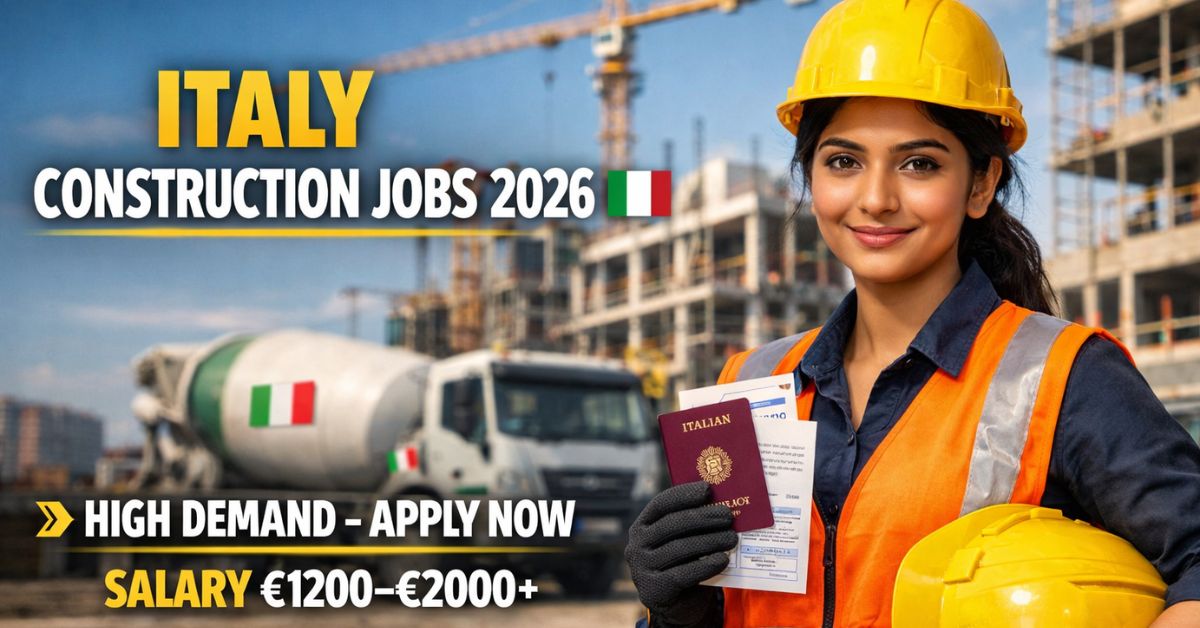
Italy Construction Worker Jobs 2026 – High Demand Jobs with Visa Sponsorship
Italian construction worker employment is also getting more appealing in 2026, particularly among foreign workers, who are willing to be employed with stable jobs, good wages, and prospects in Europe. As infrastructure projects, urbanization, and redevelopment of historic structures proceed, the construction industry in Italy remains stable with regards to demand of skilled and semi-skilled employees.
Nevertheless, most job seekers are faced with problems including difficulties in knowing the visa requirements, locating credible job opportunities and meeting the eligibility criteria. In the absence of appropriate guidance, the process may be intimidating and daunting.
Construction Jobs in Italy 2026 overview
Italy’s construction industry is one of the key sectors contributing to the country’s economic growth. By 2026, construction workers are inspired by:
- Infrastructure modernization projects
- Residential and commercial construction
- Historic buildings restoration.
- Sustainable building and green energy.
In some areas, as a result of labor shortages, employers are more willing to take on foreign workers, particularly in physically demanding jobs and skilled trades.
To the international applicants, construction employment offers a gateway to the European workforce especially to those who do not hold advanced qualifications. Such positions do not necessarily demand educational qualifications but practical skills, and this means that there is a large pool of candidates who can be hired.
The Major Construction Worker Job Highlights in Italy
The following are some of the key things you ought to be aware of:
- High Demand: The continued infrastructural developments are raising the number of jobs.
- Obviously, the salary range will be between 1,200 and 2,500 per month based on experience.
- Work Hours: 8-10 hours a day.
- Availability of Visas: Seasonal and non seasonal work visa.
- Skilled Workers: Both skilled and unskilled have opportunities.
- Language: Simple Italian is useful but not compulsory.
These points indicate that Italian construction employment is not only available, but it has long-term career development opportunities as well.
Construction Job types in Italy
General Laborers
General laborers will be engaged in simple chores including:
- Carrying materials
- Cleaning construction sites
- Assisting skilled workers
This job is best suited to novices with little or no experience.
Skilled Trades Workers
Such occupations demand certain knowledge, such as:
- Electricians
- Plumbers
- Welders
- Carpenters
Experienced employees tend to have better pay and are more stable in jobs.
Machine Operators
The operators of the machines deal with heavy machinery such as:
- Excavators
- Bulldozers
- Cranes
Usually experience and safety training is required.
Construction Supervisors
Supervisors supervise teams and make sure the project runs smoothly. This position has experience and leadership requirements.
Salary and Benefits
The wages of the construction workers in Italy differ depending on experience, job category and area.
Average Salary Range
- Entry-level: €1,200 – €1,500/month
- Mid-level: €1,500 – €2,000/month
- Skilled workers: €2,000 – €2,500/month
Additional Benefits
- Overtime pay
- Accommodation (sometimes provided)
- Health insurance
- Paid leave (on the basis of the contract)
Salaries can vary, but Italy is an equal opportunity work-life place with European labor protections.
Prerequisites to work in Italy construction industry
There are some requirements that you must meet before applying:
Basic Requirements
- Valid passport
- Italian job offer.
- Work visa approval
- Basic health fitness
Skills & Qualifications
- Physical stamina
- Basic construction knowledge
- Experience (desired but not necessary)
- Safety awareness
Language Requirement
Even though it is not a requirement, learning some basic Italian can go a long way in helping you to be hired and fit in at work.
Work Visa Process for Italy
In Italy, to legally work, you need to acquire a work visa within the Decreto Flussi (Flow Decree) system.
Types of Work Visas
Seasonal Work Visa
Suitable for temporary jobs
Non-Seasonal Work Visa
Perfect in the long-term jobs.
Key Steps in Visa Process
- Employer requests work authorization.
- Quota is approved by government through Decreto Flussi.
- Employer gets visa application in his country of origin.
- Go to Italy and request residence permit.
This is done so that it grants legal employment and protection under the Italian labor laws.
How to apply to construction jobs step-by-step.
Step 1: Prepare Your Documents
- Updated CV
- Passport
- Experience certificates
Step 2: Find Jobs
Use trusted sources such as:
- Official job portals
- Recruitment agencies
- Company websites
Step 3: Apply Online
Provide correct information and supporting documents in the applications.
Step 4: Attend Interview
Other employers can interview using the internet or agents.
Step 5: Accept Job Offer
After you are chosen your employer will start the visa process.
Step 6: Apply for Visa
Send your application to the Italian embassy.
Step 7: Travel to Italy
Once your visa is approved, then you can travel and work legally.
Advantages of Work in Italy
There are a number of strengths to working in Italy:
Stable Employment
Construction works are a steady source of employment.
European Work Experience
Experience in Italy may open up to other countries in the EU.
Cultural Exposure
Italy provides you with the opportunity to explore rich culture, food, and lifestyle.
Skill Development
- Technical and practical skills can be enhanced with time.
Work Environment and Daily Life of Construction Workers in Italy
It is crucial to know the actual working conditions when seeking construction worker employment in Italy in 2026. The vast majority of construction workers are working on an external location, though some can work internally in case of the renovation or infrastructure work.
Typical Work Environment
- Active construction sites (buildings, roads, bridges)
- Weather conditions (heat, cold, rain)
- Safety-controlled workplaces that have protective equipment.
- Team-based work culture
Employees normally report to work early in the morning and might be allowed to take breaks, according to the labor laws and organizational policies. The Italian labor legislation has a focus on the safety of the worker, and thus, the use of helmets, gloves, boots, and reflective vests is usually mandatory.
Daily Responsibilities
A normal day might consist of:
- Assembling tools and materials.
- Following supervisor instructions
- Helping with construction.
- Maintaining safety standards
- Clean up and set up of work areas.
Knowing this routine assists an applicant to get ready physically and mentally to the job.
Italy Construction Workers Cost of Living
Living standards need to be learnt before relocating to another country so that you can properly manage your money.
Average Monthly Expenses
- Accommodation: €300 – €800
- Food: €150 – €300
- Transport: €50 – €100
- Utilities: €100 – €200
Key Insight
Salaries can be considered moderate, but with proper budgeting, workers can get to save, particularly when the employer offers accommodation.
Big cities such as Rome and Milan are costly, whereas the small towns are cheaper to live in.
Best Cities in Italy for Construction Jobs
Italy has some regions that’re better than others for construction jobs because of all the development projects that are going on.
Construction jobs in Italy are available in cities.
Top Cities for Construction Work
Milan
- Milan has a demand for construction workers because of all the commercial development
- Construction workers with skills have opportunities in Milan
Rome
- Rome has a lot of buildings that need renovation
- There are also a lot of tourism-related infrastructure projects in Rome
Turin
- Turin has a lot of construction projects
- The job market in Turin is growing
Bologna
- Bologna has a balance of cost of living and job availability
Naples
- Naples has a lot of infrastructure projects that are increasing
- Choosing the city in Italy can really improve your job prospects and your quality of life.
Safety Standards and Worker Rights in Italy
Italy has strict labor laws to protect workers, including people from other countries who come to work in Italy.
Worker Rights in Italy
- Workers in Italy get wages as per their contract
- Workers in Italy have working conditions
- Workers in Italy often get paid leave
- Workers in Italy have access to healthcare service
Safety Measures in Italy
- Construction workers in Italy have to do safety training
- Construction workers in Italy are given equipment
- Construction sites in Italy are inspected regularly
All these protections make Italy a safe place for construction workers.
How to Avoid Job Scams
When you are looking for construction jobs in Italy you have to be very careful and avoid job offers.
Warning Signs of Scams
- If someone asks you for a lot of money upfront it is probably a scam
- If there is no job contract it is probably a scam
- If someone promises you a salary that’s too good to be true it is probably a scam
- If you cannot verify the company it is probably a scam
Safe Practices
- You should apply for jobs through websites
- You should verify the employers details
- You should not share information unless you have to
If you are careful you can protect yourself from losing money and getting into legal trouble.
Career Growth Opportunities in Construction Sector
Construction jobs in Italy are not just temporary they can also lead to long-term career growth.
Career Path Example
- You can start as a laborer then become a skilled worker then a supervisor and finally a site manager
Skill Development Opportunities
- You can learn trades
- You can get certifications
- You can improve your language skills
With experience construction workers in Italy can move into paying roles or even start their own businesses.
Required Documents Checklist
Before you apply for a construction job in Italy you need to have certain documents ready.
- You need a passport
- You need an updated CV in the format
- You need a job offer letter
- You need work permit approval
- You need visa application document
- You may need a certificate
Having these documents ready will make the application process faster.
Expert Tips for Job Success
To increase your chances of getting a construction job in Italy you should follow these tips.
- You should learn Italian phrases
- You should only apply through verified platforms
- You should not pay upfront fees to agents
- You should build a CV with relevant experience
- You should stay updated on visa quotas
If you are consistent and prepared you can increase your chances of getting a job.
Common Mistakes to Avoid
Many people fail to get construction jobs in Italy because of mistakes that can be avoided.
- Applying without documents is a mistake
- Falling for job scams is a mistake
- Ignoring visa requirements is a mistake
- Not verifying employer authenticity is a mistake
- Not preparing for interviews is a mistake
If you avoid these mistakes you can save time, money and effort.
Also Read: Hotel Staff Jobs in Italy 2026 – Work Visa | Salary & Requirements
FAQs
-
Can I get a construction job in Italy without experience?
Yes you can get a construction job in Italy without experience especially if you are willing to do labor work.
-
Is Italian language required?
No Italian language is not required,. It is highly recommended that you learn basic Italian phrases.
-
How long does the visa process take?
The visa process can take a weeks to several months depending on the quotas and approvals.
-
Are construction jobs permanent?
Some construction jobs in Italy are temporary while others offer long-term contracts.
-
Is accommodation provided?
Some employers in Italy provide housing. It depends on the job offer.
Final Thoughts
Construction worker jobs in Italy are an option for people who want to work abroad.Italy has a lot of construction jobs and the visa process is structured.There are opportunities for both unskilled workers, in Italy.However to be successful you need to make decisions.
You need to understand the visa process prepare the documents and avoid scams.You should also learn Italian phrases and gain practical experience.Do not rush into things take an approach.Research thoroughly apply through sources and stay consistent.If you do all these things working in Italys construction sector can be an rewarding experience.